
 Whatsapp
Six Trigonometric Functions: Domain, Range and Period
Understand the domain, range, period and asymptotes of all six trigonometric functions with a reference table, labelled graphs and solved examples.
- 11th
- Study Advice

You remember that sine stays between -1 and 1. Then a question asks for the range of cosec x, the period of tan 3x, or the values excluded from sec 2x. Suddenly, the familiar table feels like six unrelated lists.
There is a much easier way to organise it. Sine and cosine supply the starting values. The other four functions divide by one of them. That one idea explains the forbidden inputs, the gaps in the ranges and the vertical asymptotes.
Domain tells you which inputs are allowed. Range tells you which outputs occur. Period tells you how far to move horizontally before the whole pattern repeats. Keep these three questions separate, and most errors disappear.
The complete reference table
Throughout this guide, angles are in radians, R means all real numbers, and n is any integer: …, -2, -1, 0, 1, 2, … . The period listed is the smallest positive period, also called the fundamental period.
| Function | Domain | Range | Period | Vertical asymptotes |
|---|---|---|---|---|
| sin x | R | [-1, 1] | 2π | None |
| cos x | R | [-1, 1] | 2π | None |
| tan x | R except π/2 + nπ | R | π | x = π/2 + nπ |
| cot x | R except nπ | R | π | x = nπ |
| sec x | R except π/2 + nπ | (-∞, -1] ∪ [1, ∞) | 2π | x = π/2 + nπ |
| cosec x | R except nπ | (-∞, -1] ∪ [1, ∞) | 2π | x = nπ |
Square brackets include an endpoint. Round brackets exclude it. The union symbol ∪ joins two separate intervals. Infinity always takes a round bracket because infinity is not a real endpoint.
The definitions behind this table are covered in OpenStax’s introduction to the other trigonometric functions. The reasoning below lets you rebuild the table if you forget an entry.
Read the six graphs together
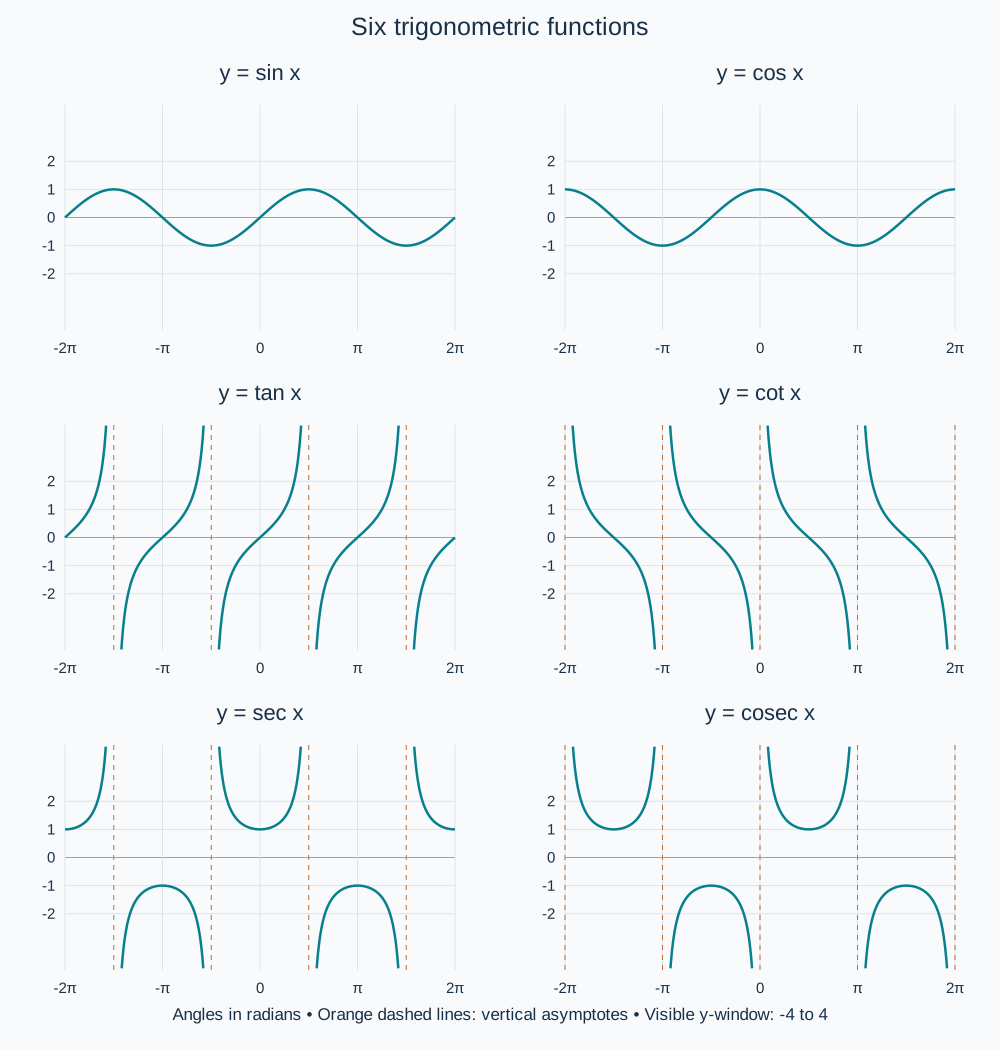
The drawing shows a finite window. A curve leaving the top of a panel does not stop there. It continues beyond the visible area.
Start by looking across each row. Sine and cosine are smooth waves with no missing inputs. Tangent and cotangent have separate branches, each covering every possible height. Secant and cosecant leave a horizontal gap between -1 and 1, but touch the boundary heights themselves.
For a written answer, accompany the graph with the domain and range. A sketch alone can hide whether an endpoint is included.
Why sine and cosine have the simplest domains
On a unit circle, the point corresponding to angle x has coordinates (cos x, sin x). You can rotate through any real angle, clockwise or anticlockwise, so both functions accept every real input.
The circle has radius 1. Neither coordinate can exceed 1 or fall below -1, and both extreme coordinates are attained. This gives the closed range [-1, 1].
A complete turn adds 2π to the angle and returns you to the same point. Consequently:
- sin(x + 2π) = sin x.
- cos(x + 2π) = cos x.
A half-turn changes both coordinate signs. For example, sin(π/2) = 1 but sin(3π/2) = -1. So π cannot be a period of sine, even though sin 0 and sin π happen to be equal.
For graph construction, mark five positions one quarter-turn apart. Sine takes the values 0, 1, 0, -1, 0 at 0, π/2, π, 3π/2, 2π. Cosine takes 1, 0, -1, 0, 1 at those same positions. Join them with smooth curves, not straight zigzags.
OpenStax’s sine and cosine graph chapter gives further graphing practice. If the coordinate signs still feel uncertain, revisit the unit circle and quadrant signs.
Find forbidden inputs by checking the denominator
Write the four remaining functions in terms of sine and cosine:
- tan x = sin x / cos x.
- cot x = cos x / sin x.
- sec x = 1 / cos x.
- cosec x = 1 / sin x.
A denominator cannot equal zero. Now you need only two zero sets:
sin x = 0 when x = nπ.
cos x = 0 when x = π/2 + nπ.
Tangent and secant divide by cosine, so they share a domain. Cotangent and cosecant divide by sine, so they share a different domain.
Notice that these exclusions extend in both directions. For tangent, -π/2 is just as forbidden as π/2. Writing only the positive excluded angles is incomplete unless the question restricts the input interval.
A useful check at zero
At x = 0, sine is 0 and cosine is 1. Therefore:
| Function | Value at x = 0 |
|---|---|
| sin x | 0 |
| cos x | 1 |
| tan x | 0 |
| cot x | Undefined |
| sec x | 1 |
| cosec x | Undefined |
This tiny table catches many swapped-domain mistakes. In particular, cot 0 is not 0 and sec 0 is not undefined.
There is also a subtle notation trap. Although cot x is often described as 1/tan x, that quotient is usable only where tan x itself exists and is nonzero. At x = π/2, cot x = cos x/sin x = 0, even though tan x is undefined. Use the sine-and-cosine definition when determining the full natural domain.
Why secant and cosecant cannot lie between -1 and 1
Suppose sin x is positive. Then 0 < sin x ≤ 1, so its reciprocal satisfies 1/sin x ≥ 1. If sin x is negative, -1 ≤ sin x < 0, so its reciprocal satisfies 1/sin x ≤ -1.
There is no third case: sin x = 0 is forbidden for cosecant.
Thus cosec x takes values at or below -1 and at or above 1. The same reasoning applies to sec x using cosine.
Try a few values to make the gap feel concrete:
- If sin x = 1, then cosec x = 1.
- If sin x = 1/2, then cosec x = 2.
- If sin x = -1/4, then cosec x = -4.
Taking a reciprocal does not squeeze these nonzero values closer to zero. It pushes their magnitudes to at least 1.
By contrast, tangent takes every real value on the interval (-π/2, π/2), and cotangent takes every real value on (0, π). Both include zero in their ranges.
Understand asymptotes without calling infinity a value
Near π/2, cos x becomes very small while sin x stays close to 1. Dividing by that small cosine makes tan x grow very large in magnitude. The line x = π/2 is a vertical asymptote.
At the asymptote itself, the function is undefined. Writing tan(π/2) = ∞ is therefore incorrect. Infinity describes unbounded behaviour nearby, not a value assigned at the missing input.
The same denominator argument gives all four asymptote families in the reference table. For these basic functions, the excluded inputs are vertical asymptotes. This is not a universal rule for every expression: simplifying a quotient can leave a removable hole instead.
For example, sin x/sin x equals 1 wherever sin x is nonzero, but remains undefined at nπ in its original form. Its graph has holes there, not vertical asymptotes. Always preserve the restrictions of the expression you were given.
None of the six basic functions has a horizontal asymptote. Repeating oscillations or repeating unbounded branches do not settle towards one fixed height as x goes to positive or negative infinity.
Why tangent and cotangent repeat sooner
After adding π, both sine and cosine change sign. In their quotient, those two sign changes cancel:
tan(x + π) = (-sin x)/(-cos x) = tan x, wherever defined.
The same happens for cotangent. Their smallest positive period is π.
For secant and cosecant, only the denominator changes sign. So sec(x + π) = -sec x and cosec(x + π) = -cosec x. Their full patterns repeat after 2π.
This explains an easy-to-miss distinction: consecutive secant asymptotes are π apart, but secant’s period is 2π. The branches alternate above and below the central gap. One branch alone is not the whole repeating pattern. The same warning applies to cosecant.
The OpenStax chapter on the other trigonometric graphs illustrates these branch patterns and transformations.
Transformations: work with the entire angle
For a function of the form y = A f(Bx + C) + D, assume A and B are nonzero real constants.
| Feature | What to do |
|---|---|
| Period | Divide the basic period by the absolute value of B |
| Forbidden inputs | Set the entire angle Bx + C equal to the basic forbidden angles, then solve for x |
| Sine or cosine range | [D - abs(A), D + abs(A)] |
| Tangent or cotangent range | R |
| Secant or cosecant range | (-∞, D - abs(A)] ∪ [D + abs(A), ∞) |
| Horizontal shift | -C/B |
Here abs(A) means the absolute value of A. It keeps the range correct even when the graph is reflected by a negative multiplier.
A vertical shift changes the heights, but not the forbidden inputs. A horizontal shift changes where the asymptotes occur, but not the distance required for a complete repeat.
If A or B is zero, examine the original expression separately. It may reduce to a constant on its allowed domain, or it may be undefined. The usual nonconstant-function period formulas do not automatically apply.
Example 1: a reflected sine wave
Find the domain, range and period of y = 3 - 2sin(4x).
The sine accepts every real input, so the domain is R.
Since -1 ≤ sin(4x) ≤ 1, multiplying by -2 gives values from -2 to 2. Adding 3 gives range [1, 5].
The period is 2π/4 = π/2. There are no vertical asymptotes. The coefficient -2 reflects the wave, but the amplitude remains 2.
Check the endpoints: when sin(4x) = 1, y = 1; when sin(4x) = -1, y = 5. Both are attained, so both brackets are square.
Example 2: shifted tangent
Find all four features of y = tan(2x - π/3).
Tangent is forbidden when its angle is π/2 + nπ:
2x - π/3 = π/2 + nπ.
2x = 5π/6 + nπ.
x = 5π/12 + nπ/2.
The domain excludes precisely these inputs. The vertical asymptotes are the lines with these x-values. The range is R and the period is π/2.
As a check, the horizontal shift is π/6. The neighbouring asymptotes around that centre are -π/12 and 5π/12. They are π/2 apart, consistent with the tangent period.
Example 3: secant with a vertical shift
Find the features of y = 2sec(x/2) + 1.
Cosine vanishes when x/2 = π/2 + nπ. Hence the excluded inputs and vertical asymptotes are x = π + 2nπ.
The period is 2π/(1/2) = 4π.
For the range, start with sec(x/2) ≤ -1 or sec(x/2) ≥ 1. Multiply by 2 and add 1:
y ≤ -1 or y ≥ 3.
Thus the range is (-∞, -1] ∪ [3, ∞). The open middle interval (-1, 3) is missing; the boundary heights are present.
Example 4: cotangent with a negative angle coefficient
Consider y = cot(π/4 - 3x).
Set its sine denominator to zero:
π/4 - 3x = nπ, giving x = π/12 - nπ/3.
Since n runs through every integer, this describes the same set as x = π/12 + nπ/3. Either form is correct.
The domain excludes that set; those lines are the vertical asymptotes. The range is R, and the period is π/3, using the absolute value of -3. A period is a positive distance.
Restricted intervals need a fresh range check
The main table assumes each function’s full natural domain. If the question supplies a smaller interval, only outputs reached within that interval belong in the range.
Example 5: sine on a short interval
For y = sin x with 0 ≤ x ≤ π/6, sine increases from 0 to 1/2. Its range is [0, 1/2], not [-1, 1].
If the upper endpoint is removed, so 0 ≤ x < π/6, the range becomes [0, 1/2). The value 1/2 is approached but never reached within that domain.
Example 6: secant on a half-open interval
For y = sec x with 0 ≤ x < π/2, cosine starts at 1 and decreases towards zero while remaining positive. Secant starts at 1 and increases without bound. The range is [1, ∞).
Do not include the negative secant branch: no permitted input in this interval reaches it. Also, do not simply call the restricted function periodic. A bounded input interval does not repeat under an unrestricted horizontal shift, even though its parent function is periodic.
A reliable answer-writing routine
- Identify the function and whether the input uses radians or degrees.
- Write any denominator restriction before simplifying.
- Solve restrictions using the entire angle inside the function.
- Find the range, including stretches, reflections, shifts and any restricted interval.
- Calculate the smallest positive period when the function is periodic.
- Label vertical asymptotes with equations such as x = π/2, not just an angle floating beside the curve.
In degrees, replace the basic 2π periods by 360° and the basic π periods by 180°. For example, tan(3x) has period 60° when x is measured in degrees, but π/3 when x is measured in radians.
For tangent, draw a rising branch between consecutive asymptotes. For cotangent, draw a falling branch. For secant and cosecant, lightly sketch the corresponding cosine or sine first, place asymptotes at its zeros, and use its ±1 points as the vertices of the reciprocal branches. Never join a curve across an asymptote.
Try these before checking the answers
For Questions 1 to 5, find the domain, range, fundamental period and vertical asymptotes.
- y = cos(5x).
- y = -3tan(x/2) + 2.
- y = cosec(2x + π/2).
- y = 4 - 2sec(3x).
- y = cot(2x + π/6).
- Find the range of cos x on [0, π/3].
- A student says sec x has period π because adjacent asymptotes are π apart. Explain the mistake.
- Is x = π an asymptote of the original expression sin x/sin x?
Answers with checks
1. Domain R; range [-1, 1]; period 2π/5; no vertical asymptotes. The 5 changes the horizontal spacing, not the wave’s height.
2. Domain excludes x = π + 2nπ; range R; period 2π; vertical asymptotes at the excluded inputs. Neither multiplying by -3 nor adding 2 removes any possible real output.
3. Set 2x + π/2 = nπ. Domain excludes x = -π/4 + nπ/2; range (-∞, -1] ∪ [1, ∞); period π; asymptotes at the excluded inputs. Notice that the asymptote spacing is π/2, half the period.
4. Domain excludes x = π/6 + nπ/3; range (-∞, 2] ∪ [6, ∞); period 2π/3; asymptotes at the excluded inputs. Test sec(3x) = 1 and -1 to obtain the two boundary heights, 2 and 6.
5. Domain excludes x = -π/12 + nπ/2; range R; period π/2; asymptotes at the excluded inputs.
6. Range [1/2, 1]. Cosine decreases from 1 to 1/2 on this interval, and both endpoints are allowed.
7. A positive secant branch becomes a negative branch after a shift of π. The graph needs a shift of 2π to reproduce the same values everywhere.
8. No. The expression equals 1 wherever it is defined. At x = π it has a missing point, but nearby outputs remain 1, so there is no unbounded behaviour and no vertical asymptote.
Frequently asked questions
What is the fastest way to remember all six domains?
Sine and cosine accept every real number. For the others, identify the denominator: cosine is zero at π/2 + nπ, while sine is zero at nπ. Exclude the appropriate set.
Which trigonometric functions have range R?
Tangent and cotangent have range R on their full natural domains. Every real output, including zero, occurs. A restricted input interval can reduce that range.
Why are -1 and 1 included in the ranges of secant and cosecant?
Their denominators can equal -1 or 1. The reciprocals then equal -1 or 1 as well, so both boundary outputs are attained.
Are csc x and cosec x different?
No. Both denote the cosecant function, defined as 1/sin x wherever sin x is nonzero.
Can a trigonometric function equal infinity?
Infinity is not a real function value. Near a vertical asymptote, outputs become unbounded in magnitude. At the excluded input, the function is undefined.
Is 2π also a period of tangent?
Yes. Any positive integer multiple of π is a period of tangent, but π is its smallest positive period. Unless told otherwise, a question asking for the period usually expects that smallest one.
Do secant and cosecant have an amplitude of 1?
No. They are unbounded, so they do not have the finite peak-to-midline amplitude used for sine and cosine. Their basic ranges have boundary heights -1 and 1, which is a different property.
Does a vertical shift change the asymptotes?
Adding a finite constant to the output does not change the x-values of vertical asymptotes. It changes the range heights. A shift inside the angle changes the horizontal positions instead.
Is the range of sin x the same as the domain of inverse sine?
The usual real inverse sine accepts inputs in [-1, 1], matching sine’s range. To define inverse sine as a function, sine’s input is restricted to a suitable interval. See the guide to inverse trigonometric functions and principal values.
What should I check before submitting a domain-and-range answer?
Check the angle unit, all denominator zeros, the integer parameter, included range endpoints and any restricted input interval. For a transformed function, solve for x after setting the complete angle equal to the forbidden angles.
Looking for commerce tuitions?
Prachi is a gold-medalist commerce teacher with experience at Deloitte and KPMG. She focuses on fundamentals to build a strong foundation.