
 Whatsapp
Modulus, Signum, and Greatest Integer Graphs: Break Points
Learn modulus, signum, and greatest integer graphs with clear diagrams, open and filled dots, negative inputs, shifted graphs, and solved questions.
- 11th
- 12th

A V-shaped graph, two horizontal rays, and a staircase. Modulus, signum, and greatest integer functions look simple enough until you have to decide what happens exactly where the graph changes.
Does the point belong to the left piece or the right piece? Why is the greatest integer of -2.3 equal to -3? And if the modulus graph has a sharp corner, does that mean it is discontinuous?
These questions have one useful habit in common: check the value just before the special input, at the input, and just after it.
We will build the three graphs from their definitions, then use that habit to handle shifts, reflections, and exam questions. You can study the basic graphs in Class 11 and return to the continuity and derivative checks when you need them in Class 12.
The Three Functions at a Glance
The domain lists allowed inputs. The range lists outputs the function actually produces.
| Function | What it tells you | Domain | Range | Main feature |
|---|---|---|---|---|
Modulus, written abs(x) | Distance of x from zero | All real numbers | All real numbers greater than or equal to zero | A connected V with its vertex at (0, 0) |
Signum, written sgn(x) | Whether x is negative, zero, or positive | All real numbers | {-1, 0, 1} | Two horizontal rays and one separate point |
Greatest integer, written floor(x) or [x] | Largest integer that does not exceed x | All real numbers | All integers | Horizontal steps with jumps at integers |
Here, abs(x) means exactly the same thing as |x|. We use floor(x) for the greatest integer function so that its notation is easy to distinguish from an interval such as [2, 3).
In interval notation, a square bracket includes the endpoint and a round bracket excludes it. Thus, [2, 3) means 2 <= x < 3.
1. Modulus: A Corner Without a Gap
The modulus, or absolute value, of a real number is its distance from zero. Distance cannot be negative. This gives the two rules used to draw the graph. OpenStax: Absolute Value Functions
| Input condition | Rule for abs(x) |
|---|---|
x < 0 | -x |
x >= 0 | x |
The first row is often where the confusion starts. If x = -5, then -x = -(-5) = 5. The expression -x is positive when x itself is negative.
Build the Graph From a Small Table
| x | -3 | -2 | -1 | 0 | 1 | 2 | 3 |
|---|---|---|---|---|---|---|---|
abs(x) | 3 | 2 | 1 | 0 | 1 | 2 | 3 |
For negative inputs, draw the line y = -x. For nonnegative inputs, draw y = x. The two pieces meet at the origin, and the origin belongs to the graph.
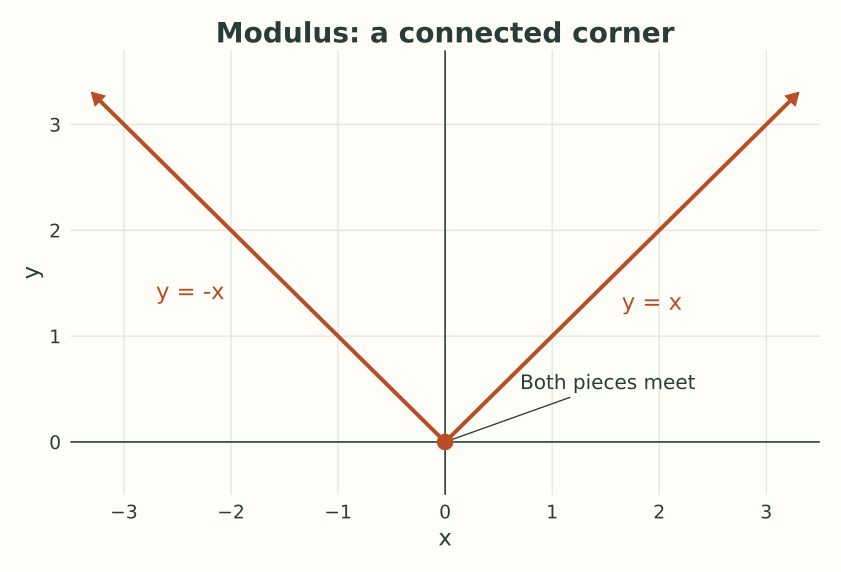
(0, 0). The direction changes there, but the graph stays connected.There is no open circle at the vertex. Both formulas would give zero at x = 0, so either branch may include equality in a correct piecewise definition, provided the definition covers the origin.
What Happens Just Before, At, and After Zero?
| Input | -0.01 | 0 | 0.01 |
|---|---|---|---|
| Output | 0.01 | 0 | 0.01 |
As the input approaches zero from either side, the output approaches zero too. The actual value at zero is also zero.
That is why modulus is continuous at zero. Its sharp corner is a change in slope, which is a different question.
Example: Draw y = abs(x - 2) + 1
First find where the expression inside the modulus becomes zero:
x - 2 = 0, so x = 2.
Now remove the modulus separately on each side:
| Input condition | Calculation | Final rule |
|---|---|---|
x < 2 | -(x - 2) + 1 | y = 3 - x |
x >= 2 | (x - 2) + 1 | y = x - 1 |
At x = 2, the output is 1. The vertex is therefore (2, 1).
Check one point on each side: at x = 1 and x = 3, the output is 2. These points sit symmetrically around the vertex.
The graph is the basic V moved two units right and one unit up. Its domain is all real numbers, and its range is y >= 1.
Be careful when there is a minus sign outside the modulus. For example, y = -abs(x - 2) + 1 is an upside-down V with the same vertex and range y <= 1.
2. Signum: The Sign Matters, Not the Size
Signum turns every negative real input into -1, zero into 0, and every positive real input into 1. For nonzero real x, it can also be written as x/abs(x). Wolfram MathWorld: Sign
| Input condition | sgn(x) |
|---|---|
x < 0 | -1 |
x = 0 | 0 |
x > 0 | 1 |
For example, sgn(-80) = -1 and sgn(-0.0001) = -1. Their sizes are very different, but both are negative.
Likewise, sgn(0.0001) = 1 and sgn(80) = 1.
Draw the Three Pieces Carefully
- Draw a horizontal ray at
y = -1forx < 0. - Put an open circle at
(0, -1)because this ray excludes zero. - Draw a horizontal ray at
y = 1forx > 0. - Put an open circle at
(0, 1). - Put one filled dot at
(0, 0)becausesgn(0) = 0.
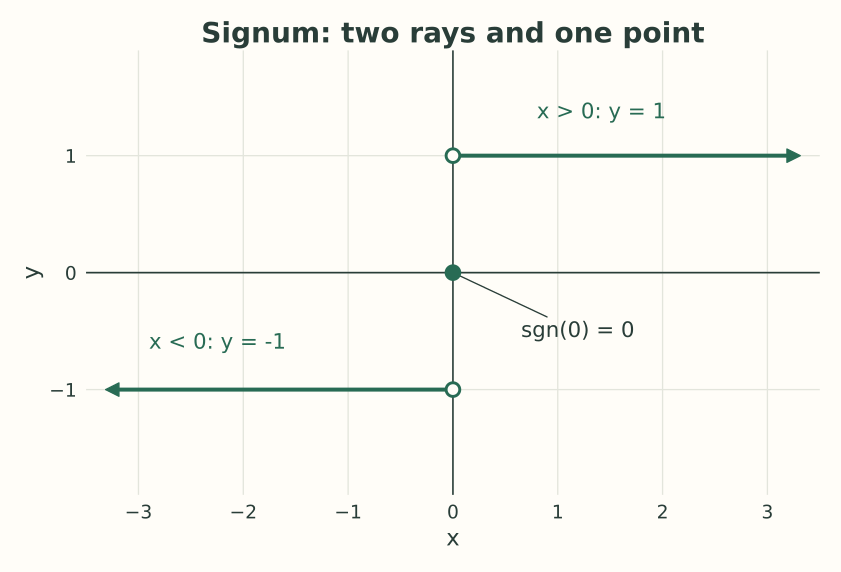
Do not draw a vertical line joining the three points. That would assign several output values to x = 0, so the picture would no longer represent this function.
Why the Filled Dot Does Not Repair the Jump
Compare these values:
| Input | -0.01 | 0 | 0.01 |
|---|---|---|---|
sgn(x) | -1 | 0 | 1 |
Moving closer to zero does not bring the negative-side outputs towards zero. They stay at -1. The positive-side outputs stay at 1.
The two sides approach different heights, so signum is discontinuous at zero. Giving the function a value at zero cannot make the two sides agree.
Example: Draw y = sgn(3 - x)
The important input satisfies 3 - x = 0, giving x = 3.
Now test the sign of the whole expression inside signum:
| Input condition | Sign of 3 - x | Output |
|---|---|---|
x < 3 | Positive | 1 |
x = 3 | Zero | 0 |
x > 3 | Negative | -1 |
The left ray is now the upper one. The right ray is the lower one. There are open circles at (3, 1) and (3, -1), with a filled dot at (3, 0).
This example is a useful check on a memorised sketch. The graph does not always jump upwards. The sign of the inner expression decides the direction.
3. Greatest Integer: Always Move Down to an Integer
The greatest integer function returns the largest integer less than or equal to its input. It is also called the floor function. Wolfram MathWorld: Floor Function
The rule that makes its graph manageable is:
floor(x) = n exactly when n <= x < n + 1, where n is an integer.
For example, all inputs from 4 up to, but excluding, 5 give the output 4.
The Negative-Number Trap
| Input | Greatest integer | Reason |
|---|---|---|
3.8 | 3 | 3 <= 3.8 < 4 |
3 | 3 | An integer is already its own floor |
0.2 | 0 | 0 <= 0.2 < 1 |
-0.2 | -1 | -1 <= -0.2 < 0 |
-2.3 | -3 | -3 <= -2.3 < -2 |
-3 | -3 | Equality is allowed |
For -2.3, the answer cannot be -2, because -2 is greater than the input. The floor must be no greater than the number you started with.
Do not simply remove the decimal part. That procedure moves negative numbers towards zero, which can give a different answer.
Build Each Step From an Interval
| Input interval | Output |
|---|---|
-3 <= x < -2 | -3 |
-2 <= x < -1 | -2 |
-1 <= x < 0 | -1 |
0 <= x < 1 | 0 |
1 <= x < 2 | 1 |
2 <= x < 3 | 2 |
Each row becomes one horizontal segment. On the basic graph, every complete step has a filled left endpoint and an open right endpoint.
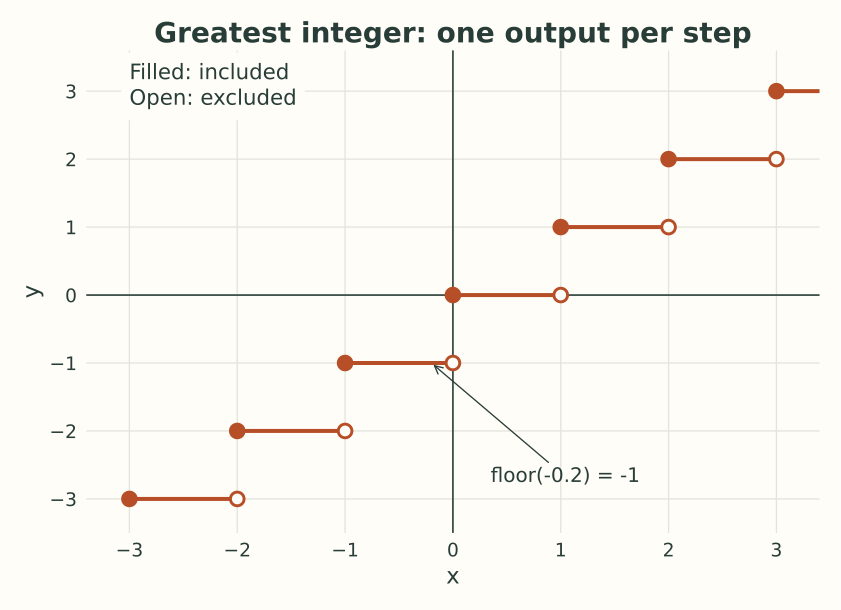
At x = 2, for example, (2, 1) is open and (2, 2) is filled. There is only one actual function value there: floor(2) = 2.
What Changes at an Integer?
Look around x = 2:
| Input | 1.99 | 2 | 2.01 |
|---|---|---|---|
floor(x) | 1 | 2 | 2 |
More generally, at any integer n:
- Approaching from the left gives outputs tending to
n - 1. - At the integer itself, the output is
n. - Approaching from the right gives outputs tending to
n.
The jump has size 1, and the function value agrees with the right side. The basic floor function is therefore right-continuous at each integer, but not continuous there from both sides.
At a non-integer such as 2.4, nearby inputs remain on the same horizontal step. The function is continuous at every non-integer real number.
Open and Filled Dots: Let the Inequality Decide
A filled dot means the point belongs to the graph. An open circle marks a point that the nearby piece approaches but excludes.
Before drawing either, look for the equality sign.
| Condition on a piece | What happens at its stated boundary? |
|---|---|
x < a | The piece excludes a |
x <= a | The piece includes a |
x > a | The piece excludes a |
x >= a | The piece includes a |
x = a | Calculate and plot the separate value |
Then check the whole function. An open circle on one piece does not mean the input is missing from the domain. Another piece or a separate filled dot may define the value there.
That is exactly what happens at zero in the signum graph and at every integer in the floor graph.
Shifted and Reflected Floor Graphs
For floor functions, solving an interval inequality is more reliable than moving a remembered staircase by eye.
Example 1: Draw y = floor(2x - 1)
Set the output equal to an integer n:
floor(2x - 1) = n
This means:
n <= 2x - 1 < n + 1
Add one, then divide by two:
(n + 1)/2 <= x < (n + 2)/2
That is the entire graph-building rule.
| Output n | Input interval |
|---|---|
-2 | -0.5 <= x < 0 |
-1 | 0 <= x < 0.5 |
0 | 0.5 <= x < 1 |
1 | 1 <= x < 1.5 |
2 | 1.5 <= x < 2 |
Each step has width 0.5. The jump points occur wherever 2x - 1 is an integer, so they are all integer multiples of 0.5.
At x = 1, the exact output is floor(1) = 1. Just to the left, the output is 0; just to the right, it is 1.
Example 2: Draw y = floor(-x)
This time:
n <= -x < n + 1
Multiplying by -1 reverses both inequalities. Reorder the result to put x in the middle:
-n - 1 < x <= -n
Now each complete step has an open left endpoint and a filled right endpoint.
For instance, output 1 occurs for -2 < x <= -1, while output -1 occurs for 0 < x <= 1.
At x = 1, the output is -1. Just to the left it is also -1, but just to the right it is -2. The reflected floor graph is left-continuous at its integer jump points.
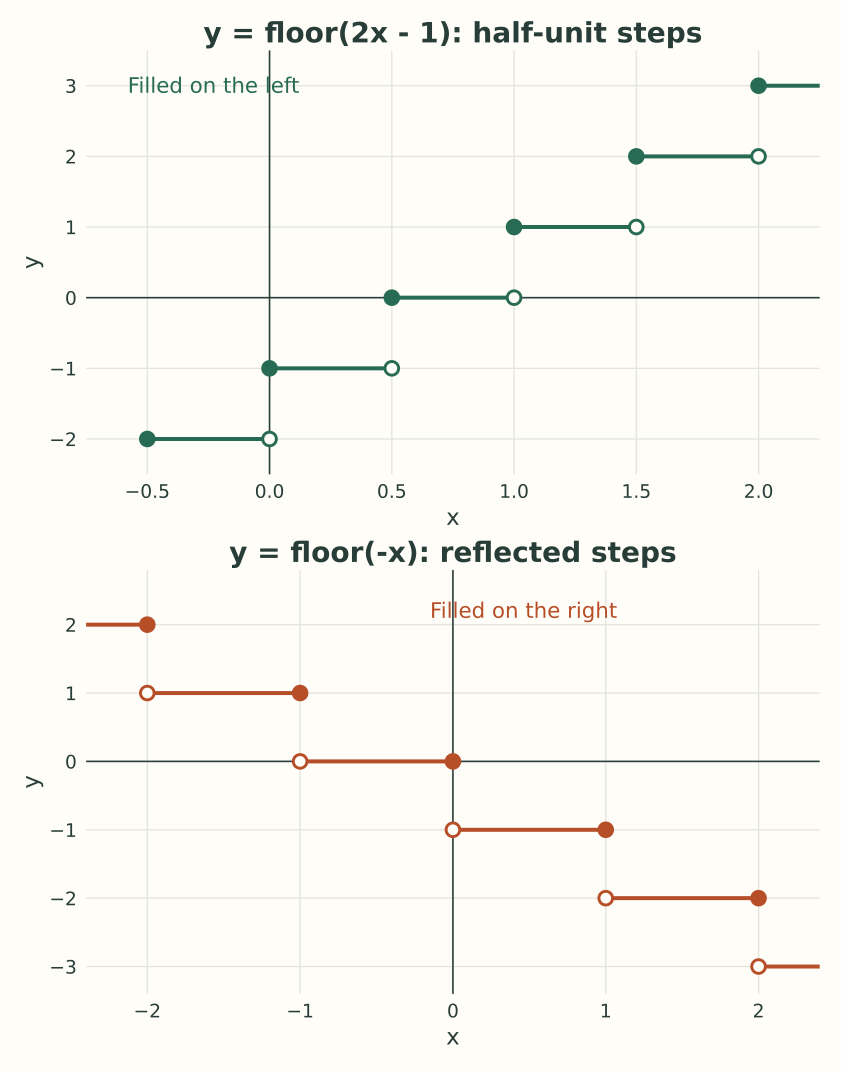
The General Linear Rule
For y = floor(ax + b), where a != 0, start with:
n <= ax + b < n + 1
The jump points satisfy:
x = (n - b)/a, for integer n.
Each step has width 1/abs(a). For positive a, the steps rise and are left-closed. For negative a, they fall and are right-closed.
An outside addition, as in floor(ax + b) + c, moves the graph vertically. It does not change these jump locations.
A Three-Column Check for Continuity
At an interior point of the domain, continuity requires the left-hand limit, right-hand limit, and actual function value to agree. A filled point alone is insufficient. OpenStax: Continuity
Use this comparison after finding the important input:
| Function and input | Left-hand limit | Actual value | Right-hand limit |
|---|---|---|---|
abs(x) at 0 | 0 | 0 | 0 |
sgn(x) at 0 | -1 | 0 | 1 |
floor(x) at integer n | n - 1 | n | n |
floor(-x) at 1 | -1 | -1 | -2 |
Only the first row has all three entries equal. The middle column answers “What is the function value?” The outer columns answer “What do nearby values approach?”
The usual notation x -> a- means approaching a from values smaller than a, and x -> a+ means approaching from larger values. The signs describe the direction of approach, not whether a is positive or negative.
For example, approaching -2 from the left means using inputs such as -2.1 and -2.01.
A Useful Caution About Compositions
The linear rules above are dependable because ax + b, with a != 0, crosses every boundary it reaches. With a nonlinear inner expression, first find candidate points and then check both sides.
Consider floor(x^2) near zero. For every -1 < x < 1, we have 0 <= x^2 < 1, so the output is 0 throughout that interval. The graph is continuous at zero even though the inner expression equals an integer there.
Similarly, abs(x^2) = x^2, so it has no corner at zero. But sgn(x^2) equals 1 on both sides of zero and equals 0 at zero. Its discontinuity there is removable, rather than a jump between different side limits.
The lesson is to inspect the resulting function. Do not automatically transfer every feature of the basic graph to a composition.
The Class 12 Connection: Continuity and Differentiability
A derivative measures the limiting slope. Differentiability implies continuity, but a continuous function need not be differentiable. The modulus graph at zero is a standard example. OpenStax: The Derivative as a Function
For abs(x), the slope is -1 on the negative side and 1 on the positive side. At zero, these slopes disagree. There is no single derivative there.
| Function | Where it is continuous | Where its derivative exists | Derivative where it exists |
|---|---|---|---|
abs(x) | Every real input | Every input except zero | -1 for x < 0; 1 for x > 0 |
sgn(x) | Every input except zero | Every input except zero | 0 |
floor(x) | Every non-integer input | Every non-integer input | 0 |
Horizontal pieces have slope zero. This does not make the derivative zero at a jump. At a discontinuity, the ordinary derivative does not exist.
You may see the shortcut “the derivative of modulus is signum.” Remember its restriction: it is true for x != 0. Although sgn(0) is defined as zero, the derivative of abs(x) at zero is undefined.
Two More Solved Questions
Solve floor(3x + 2) = -2
Translate the floor statement into an interval:
-2 <= 3x + 2 < -1
Subtract two:
-4 <= 3x < -3
Divide by three:
-4/3 <= x < -1
Check the endpoints. At x = -4/3, the inner expression is -2, which works. At x = -1, it is -1, whose floor is -1, so that endpoint must be excluded.
Find the Range of floor(x) for -1.4 <= x < 2
The lowest allowed input, -1.4, gives -2.
Moving right, the outputs -1, 0, and 1 all occur. The input never reaches 2, so output 2 does not occur.
The range is {-2, -1, 0, 1}.
Do not write the interval [-2, 1]. That interval contains non-integers such as 0.5, but a floor function cannot produce them.
If domain and range still feel interchangeable, the first sections of our guide to inverse and composite functions can help you separate the input set from the output set.
Common Mistakes and Quick Repairs
| Mistake | Repair |
|---|---|
| Saying modulus is always positive | Say nonnegative: zero is a possible output |
| Calling the modulus vertex a discontinuity | Compare the side limits and the actual value |
| Drawing signum as three horizontal lines | Zero contributes one point, not a whole line |
Replacing signum by x/abs(x) at zero | State the value at zero separately |
Writing floor(-2.3) = -2 | Check that the answer does not exceed the input |
| Joining floor steps vertically | Leave the jump unconnected |
| Assuming every floor graph is filled on the left | Solve the interval, especially after reflection |
| Substituting the boundary to find both side limits | Use the correct expression on each side |
| Listing only positive floor jump points | Include zero and negative integers too |
| Writing a continuous interval for a floor range | List the integer outputs that actually occur |
Try These Before Reading the Answers
- Find
abs(-4.6),sgn(-4.6), andfloor(-4.6). - State the vertex and range of
y = abs(2x + 6) - 4. - Describe the graph of
y = sgn(x + 2)at its break point. - Solve
floor(4 - 2x) = 1, keeping the endpoint signs correct. - Find the left-hand limit, actual value, and right-hand limit of
floor(x)atx = -2. - Find the range of
floor(x)when-0.2 < x <= 2.2. - Decide whether
abs(x - 5)is continuous and differentiable atx = 5. - Is
floor(x^2)discontinuous at zero just becausex^2 = 0there?
Answers With Reasons
1. The answers are 4.6, -1, and -5. Modulus measures distance; signum reports the sign; floor chooses the integer below or equal to the input.
2. Solve 2x + 6 = 0, giving x = -3. The vertex is (-3, -4), and the range is y >= -4.
3. The break point is x = -2. The left ray has height -1, the right ray has height 1, and both exclude their boundary points. The filled point is (-2, 0).
4. Start with 1 <= 4 - 2x < 2. Subtract four to get -3 <= -2x < -2. Dividing by -2 reverses the signs, giving 1 < x <= 1.5.
5. The three values are -3, -2, and -2. Inputs just below -2 belong to the step at height -3.
6. The range is {-1, 0, 1, 2}. Negative inputs close to zero give -1; allowed inputs from 2 to 2.2 give 2.
7. It is continuous at 5, because both branches meet at (5, 0). It is not differentiable there, because its left and right slopes are -1 and 1.
8. No. Throughout -1 < x < 1, the output is zero. There is no discontinuity at zero.
Frequently Asked Questions
What is the difference between modulus, signum, and greatest integer functions?
Modulus gives distance from zero, signum gives -1, 0, or 1 according to the input’s sign, and greatest integer gives the largest integer that does not exceed the input. For -1.7, their outputs are 1.7, -1, and -2 respectively.
Is the modulus function continuous at zero?
Yes. The outputs approach zero from both sides, and the actual value at zero is zero. The graph has a corner, but no gap.
Why is modulus not differentiable at zero?
Its left-hand slope is -1, while its right-hand slope is 1. Since these do not agree, the derivative at zero does not exist.
What is the value of signum at zero?
Under the standard real signum definition, sgn(0) = 0. Draw a filled dot at the origin and open circles at (0, -1) and (0, 1).
Does the filled dot make signum continuous at zero?
No. The left-hand limit is -1, and the right-hand limit is 1. Changing the value of the single point cannot make those side limits agree.
Why is the greatest integer of a negative decimal smaller than expected?
The floor must be less than or equal to the input. For example, floor(-0.4) = -1 because zero is greater than -0.4. Think of moving left along the number line until you reach an integer.
Is the greatest integer function the same as rounding?
No. Rounding to the nearest integer can move up or down. Floor always chooses the largest integer no greater than the input. For example, floor(2.9) = 2, while rounding 2.9 to the nearest integer gives 3.
Where is the greatest integer function discontinuous?
The basic function floor(x) is discontinuous at every integer, including negative integers and zero. It is continuous between successive integers.
Why are the basic floor graph’s left endpoints filled?
Output n applies on n <= x < n + 1. The left boundary is included, and the right boundary is excluded. This endpoint pattern reverses for floor(-x).
How do I find break points in a transformed graph?
For modulus or signum of a linear expression, set the expression inside equal to zero. For floor(ax + b), with a != 0, set ax + b equal to an integer. Then calculate the exact value and inspect both sides.
Can a step function have derivative zero and still jump?
Yes. The basic floor function has derivative zero inside every step. Its derivative is undefined at the integers where it jumps. A statement about the derivative must include where it applies.
What is the quickest reliable way to sketch these graphs?
Write the definition, find the important inputs, and divide the number line into intervals. Draw each piece, calculate every boundary value separately, and place open or filled dots from the inequalities. Finish by checking the domain and range against your sketch.
Looking for commerce tuitions?
Prachi is a gold-medalist commerce teacher with experience at Deloitte and KPMG. She focuses on fundamentals to build a strong foundation.