
 Whatsapp
Limits at a Point: Left-Hand, Right-Hand and 0/0 Forms
Understand left-hand and right-hand limits, solve 0/0 forms, and distinguish limits from function values with worked examples and practice answers.
- 11th
- 12th

You substitute a number into a fraction, get 0/0, and wonder whether the answer is zero, one, or simply impossible.
Pause there. That calculation has not given you a limit. It has told you that direct substitution cannot finish the question.
Limits become much friendlier when you separate three questions: What happens just before a point? What happens just after it? And what happens exactly at it? The first two determine a two-sided limit. The third tells you the function’s value.
Let’s work through those questions with numbers, graphs, and a few examples where the obvious shortcut goes wrong.
What does a limit at a point mean?
Writing lim as x → a of f(x) = L means that f(x) can be made as close as we want to L by taking x sufficiently close to a, while keeping x different from a.
The phrase “as close as we want” matters. A limit is stronger than saying that a few calculator readings look similar.
For example, take f(x) = 3x + 2 near x = 4.
| From below 4 | f(x) | From above 4 | f(x) |
|---|---|---|---|
| 3.9 | 13.7 | 4.1 | 14.3 |
| 3.99 | 13.97 | 4.01 | 14.03 |
| 3.999 | 13.997 | 4.001 | 14.003 |
Both sets of outputs approach 14. Here we can go beyond the table: the distance of f(x) from 14 is exactly three times the distance of x from 4. Making the second distance small makes the first small too.
So lim as x → 4 of (3x + 2) = 14.
This particular function also has f(4) = 14. Later, we will change the value at 4 and see why the limit survives.
The introductory treatment in NCERT’s Limits and Derivatives chapter develops limits through nearby values and then distinguishes the two directions of approach.
Left-hand limit and right-hand limit
A left-hand limit uses x-values smaller than a. A right-hand limit uses x-values larger than a.
| Notation | Read it as | Values used near 4 |
|---|---|---|
| x → a⁻ | x approaches a from the left | 3.9, 3.99, 3.999 |
| x → a⁺ | x approaches a from the right | 4.1, 4.01, 4.001 |
| x → a | x approaches a from either side | Both sets |
The superscript minus does not mean that x is negative. When x approaches 4 from the left, x can be positive throughout. Similarly, approaching -3 from the right means using values such as -2.9 and -2.99.
For an interior point with the function defined on both sides nearby, a finite two-sided limit exists precisely when the two one-sided limits exist and equal the same finite number.
LHL = RHL = L ⇒ two-sided limit = L.
If LHL = 6 and RHL = 9, there is no two-sided limit. You cannot average them and report 7.5.
If you prefer the small-step method, put x = a - h for the left side and x = a + h for the right side, taking h → 0⁺ in both cases. Keeping h positive prevents the two directions from becoming muddled.
OpenStax’s explanation of one-sided limits includes the matching-sides criterion and examples where a limit fails to exist.
A limit can exist even when the point has a different value
Define a function like this:
- f(x) = 3x + 2 when x ≠ 4.
- f(4) = 5.
For every nearby x other than 4, we still use 3x + 2. Therefore:
LHL = 14, RHL = 14, but f(4) = 5.
The two-sided limit is 14. The isolated value 5 cannot change what happens at all the surrounding points.
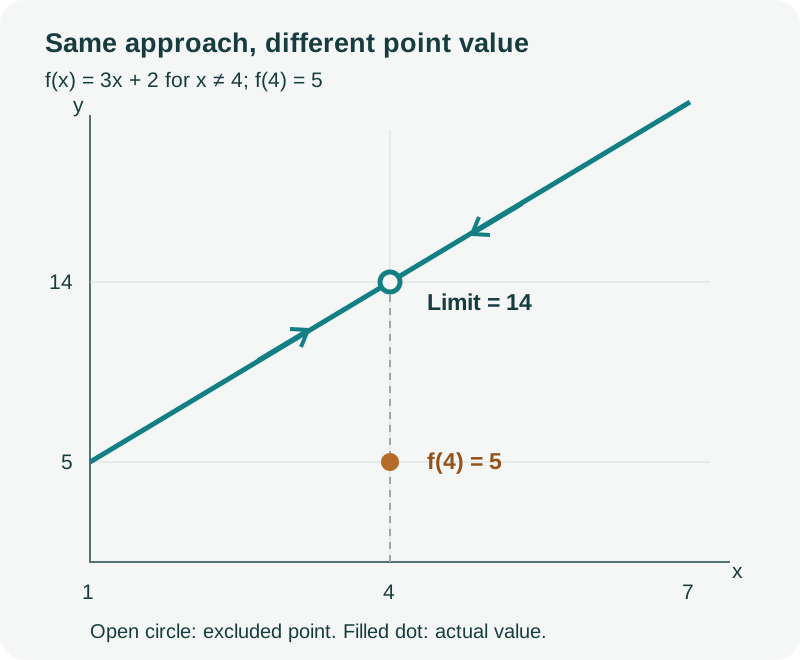
This also separates having a limit from being continuous. At an interior point a, continuity requires f(a) to be defined, the finite limit to exist, and that limit to equal f(a). Our example fails the last condition. Changing f(4) to 14 would make it continuous there.
See OpenStax’s continuity conditions for the formal connection.
Worked example 1: different formulas on the two sides
Suppose:
- f(x) = 2x + 1 when x < 3.
- f(x) = x + 5 when x ≥ 3.
From the left, use 2x + 1. Its limiting value is 2(3) + 1 = 7.
From the right, use x + 5. Its limiting value is 3 + 5 = 8.
Since 7 ≠ 8, the two-sided limit at 3 does not exist.
The definition gives f(3) = 8 because the second branch includes equality. That fact answers the value question, but it cannot repair the disagreement between the sides.
Worked example 2: find a parameter that makes the limit exist
Suppose:
- f(x) = kx + 2 when x < 2.
- f(x) = x² + 4 when x > 2.
- f(2) = 11.
Find k so that the two-sided limit at 2 exists.
The left side approaches 2k + 2. The right side approaches 2² + 4 = 8.
Equating them gives:
2k + 2 = 8 ⇒ k = 3.
With k = 3, the limit is 8. Notice that f(2) = 11 was irrelevant to finding k.
If the question also required continuity, k = 3 alone would not be enough. The assigned value at 2 would have to change from 11 to 8. No choice of k can make this particular function continuous while f(2) remains 11, because the right-hand limit is fixed at 8.
Why is 0/0 called an indeterminate form?
When both numerator and denominator approach zero, their separate limits do not tell us how fast each expression is shrinking. The ratio needs more investigation.
These three original examples all produce the form 0/0 at x = 5:
| Expression | For x ≠ 5, it simplifies to | Limit at 5 |
|---|---|---|
| (x - 5)/(x - 5) | 1 | 1 |
| (x - 5)²/(x - 5) | x - 5 | 0 |
| (x - 5)/(x - 5)² | 1/(x - 5) | No finite two-sided limit |
The same substitution form can hide completely different behaviours. That is why 0/0 is neither a numerical answer nor proof that the limit does not exist.
Be careful with the language: 0/0 remains undefined as arithmetic. “Indeterminate form” describes a limit situation in which the numerator and denominator both tend to zero.
Worked example 3: remove a common factor
Evaluate the limit as x → 5 of:
(x² - 25)/(x - 5).
Direct substitution gives the form 0/0. Factor the numerator:
x² - 25 = (x - 5)(x + 5).
For x ≠ 5:
(x² - 25)/(x - 5) = x + 5.
The limit is therefore 5 + 5 = 10.
We have not divided by zero. We cancelled x - 5 at nearby points where it is nonzero. That is exactly the region the limit investigates.
The original fraction is still undefined at 5. The simplified formula lets us calculate its limiting behaviour, not retroactively assign a value to the original expression.
This use of expressions that agree around a point is explained in OpenStax’s limit laws and simplification methods.
Worked example 4: rationalise a square root
Evaluate the limit as x → 7 of:
[√(x + 9) - 4]/(x - 7).
Substitution produces 0/0 again. There is no obvious polynomial factor in the numerator, so multiply numerator and denominator by the conjugate, √(x + 9) + 4.
The numerator becomes:
(x + 9) - 16 = x - 7.
Thus, for x ≠ 7 near the point:
[√(x + 9) - 4]/(x - 7) = 1/[√(x + 9) + 4].
Now substitution is valid:
Limit = 1/(4 + 4) = 1/8.
A quick reasonableness check helps: just above 7, both the original numerator and denominator are positive. Just below 7, both are negative. A positive answer fits both sides.
Worked example 5: combine fractions first
Evaluate the limit as x → 4 of:
[1/(x + 1) - 1/5]/(x - 4).
First combine the two fractions in the numerator:
1/(x + 1) - 1/5 = [5 - (x + 1)]/[5(x + 1)]
= (4 - x)/[5(x + 1)]
= -(x - 4)/[5(x + 1)].
Dividing by x - 4 and cancelling for x ≠ 4 leaves:
-1/[5(x + 1)].
The required limit is -1/25.
The minus sign is easy to lose. Writing 4 - x = -(x - 4) explicitly protects it. A negative answer also makes sense: when x increases slightly above 4, 1/(x + 1) falls below 1/5.
Worked example 6: absolute value demands a sign check
Evaluate the two-sided limit at 3 of:
|x - 3|/(x - 3).
The vertical bars mean absolute value. Their meaning depends on the sign of x - 3.
For x < 3, x - 3 is negative, so |x - 3| = -(x - 3). The fraction equals -1.
For x > 3, x - 3 is positive, so |x - 3| = x - 3. The fraction equals 1.
Therefore LHL = -1 and RHL = 1, and the two-sided limit does not exist.
Do not cancel the bars as if they were brackets. For instance, at x = 2.9, the numerator is 0.1 but the denominator is -0.1. That single check exposes the incorrect claim that the ratio is always 1.
What if substitution gives a nonzero number over zero?
This is different from 0/0. Consider 6/(x - 3) as x approaches 3.
From the left, x - 3 is a small negative number, so the quotient decreases without bound. We write LHL = -∞.
From the right, the denominator is small and positive, so the quotient increases without bound. We write RHL = +∞.
There is no two-sided limit here, even in the extended sense, because the sides have opposite behaviours.
Now change the expression to 6/(x - 3)². The squared denominator is positive on both sides and tends to zero. Both sides grow without bound, so we write:
lim as x → 3 of 6/(x - 3)² = +∞.
That notation describes an infinite limit. It does not claim that infinity is a real-number value or that the function has a finite limit.
Paul Dawkins’ notes at Lamar University provide further examples of checking direction and unbounded behaviour.
Other indeterminate forms worth recognising
You will also meet forms written as ∞/∞, 0 × ∞, ∞ - ∞, 1^∞, 0^0, and ∞^0. These describe competing behaviours, not ordinary arithmetic with infinity. In particular, the limit form 0^0 is a separate issue from conventions used for 0^0 in other areas of mathematics.
Here is an example of ∞/∞ at a finite point. As x → 0⁺, consider:
(3/x² + 2/x)/(5/x² - 1).
Both numerator and denominator tend to +∞. Multiplying top and bottom by x² gives:
(3 + 2x)/(5 - x²).
Now the limit is 3/5.
For a difference example, let x → 0⁺ in:
1/x - 1/(x + x²).
Both terms tend to +∞, but combining them gives:
[(1 + x) - 1]/[x(1 + x)] = 1/(1 + x).
The limit is 1, not zero. Two quantities growing without bound need not have a difference approaching zero.
OpenStax’s discussion of indeterminate forms explains the broader family. For the algebraic examples here, factorisation, conjugates, and common denominators are sufficient; there is no need to introduce a differentiation shortcut.
A reliable order for solving a limit question
- Read the approach carefully. Note the point and any left or right superscript.
- Check the domain. Are nearby real inputs available on the requested side?
- Select the branch if needed. An absolute value or piecewise definition may need separate calculations.
- Try substitution where appropriate. Polynomials allow it; a rational function allows it when its denominator at the point is nonzero.
- If you obtain 0/0, simplify. Factor, rationalise, or combine fractions, retaining any exclusions.
- If the denominator tends to zero while the numerator tends to a nonzero number, inspect signs. Do not simply write “infinity.”
- Give the requested conclusion. A two-sided question needs agreement between the sides; continuity additionally needs the point value to match.
For a domain example, √(x - 6) has real inputs only when x ≥ 6. Its right-hand limit at 6 is zero. There are no real inputs immediately to the left. In the usual school convention requiring both sides for a two-sided limit, the left-hand limit is unavailable. Write the right-hand statement explicitly rather than inventing negative radicands.
Some advanced texts define endpoint limits relative to the domain. That convention does not change the practical fact that this square-root example can only be approached from the right.
Quick practice with worked answers
Try these without reading the answers first. All limits are two-sided unless a direction is specified.
- Find the limit of 2x² - x + 3 as x → 2.
- Find the limit of (x² - 36)/(x - 6) as x → 6.
- Find the limit of [√(x + 16) - 5]/(x - 9) as x → 9.
- Find the LHL and RHL of |x + 2|/(x + 2) at -2.
- A function equals ax - 1 for x < 3 and x + 5 for x > 3. Which a makes its limit at 3 exist?
- In question 5, suppose f(3) = 10. Is it continuous after choosing that a?
- Find the one-sided limits of 4/(x - 2) at 2.
- Find the right-hand limit of √(x - 8) at 8.
Answers and reasoning
1. 9. Substitute into the polynomial: 2(4) - 2 + 3 = 9.
2. 12. Factor x² - 36 as (x - 6)(x + 6). The nearby expression reduces to x + 6.
3. 1/10. Multiply by the conjugate. The numerator becomes x - 9, leaving 1/[√(x + 16) + 5].
4. LHL = -1; RHL = 1. To the left of -2, x + 2 is negative; to the right, it is positive. No two-sided limit exists.
5. a = 3. Equate 3a - 1 and 8. Then 3a = 9. The common limit is 8.
6. No. The limit is 8 but the function value is 10. Continuity would require f(3) = 8.
7. LHL = -∞; RHL = +∞. The numerator stays positive while the denominator changes sign across 2. There is no two-sided limit.
8. 0. For x = 8 + h with h > 0, the expression is √h, which tends to zero as h → 0⁺.
Frequently asked questions
Does f(a) have to exist for the limit at a to exist?
No. The fraction (x² - 25)/(x - 5) is undefined at 5 but has limit 10 there. Nearby inputs determine the limit.
Does a⁻ mean approaching a negative number?
No. It means approaching a through values smaller than a. You can approach 4 from the left using 3.9 and 3.99, both of which are positive.
If LHL and RHL are equal, is the function continuous?
Not automatically. Their common finite value gives the two-sided limit. Continuity also requires the function’s value at the point to exist and equal that limit.
Is 0/0 equal to zero or one?
Neither. Division by zero is undefined. In a limit calculation, the form 0/0 means that the expression needs further analysis before you can decide the limiting behaviour.
Why can we cancel x - a if x is approaching a?
Because approaching a does not mean substituting a at every step. At nearby points with x ≠ a, x - a is nonzero, so cancellation is valid there.
Can I use a table to prove a limit?
A table is useful for spotting a pattern and checking an answer, but a finite collection of readings cannot establish all nearby behaviour. Use algebra, a suitable limit law, or another valid argument to justify the conclusion.
Is an infinite limit the same as a finite limit?
No. A finite limit is a real number that the outputs approach. An infinite limit describes outputs growing without bound in a specified direction.
Can a limit fail even without a jump or a vertical asymptote?
Yes. For example, sin(1/x) oscillates endlessly as x approaches zero and does not settle at one number. Different sequences of inputs approaching zero give outputs 1 and -1. Those incompatible outputs prevent a limit.
Should I always calculate LHL and RHL separately?
It is especially useful for piecewise functions, absolute values, and denominators tending to zero. For a polynomial, or a rational function with a nonzero denominator at the point, direct substitution already gives the common result.
What should I write when the two sides disagree?
State both one-sided results, then conclude that the two-sided limit does not exist because they are unequal. Showing the disagreement is the reason for the answer.
Looking for commerce tuitions?
Prachi is a gold-medalist commerce teacher with experience at Deloitte and KPMG. She focuses on fundamentals to build a strong foundation.