
 Whatsapp
Indifference Curve Properties: MRS and Why Curves Cannot Cross
Understand indifference curve properties with MRS calculations, clear diagrams, a non-intersection proof, special cases, and solved practice questions.
- 11th
- 12th
- Economics

Imagine choosing a snack basket. One basket has more strawberries and fewer grapes. Another has fewer strawberries and more grapes. You look at both and think, “I would be equally happy with either.”
That small decision is the starting point of an indifference curve. The quantities change, but your satisfaction stays the same.
Once you hold on to that idea, the familiar rules become easier to explain. Why does the curve slope down? Why does it usually flatten as we move right? Why would two crossing curves create a contradiction?
We will answer each question with a basket example, a calculation, or a diagram. You will also see which rules depend on assumptions, so you can handle an unfamiliar question without guessing.
What Is an Indifference Curve?
An indifference curve shows combinations of two goods that give a particular consumer equal satisfaction. A combination is often called a bundle. With X on the horizontal axis and Y on the vertical axis, the point (3, 8) represents 3 units of X and 8 units of Y.
A family of these curves is an indifference map. Each curve represents a different satisfaction level. For two desirable goods, a curve lying to the northeast represents a preferred set of bundles. NCERT: Theory of Consumer Behaviour
Think of contours on a hill. Walking along one contour changes your position without changing your height. Moving to a higher contour changes the height itself. Here, the “height” stands for satisfaction.
The analogy has a limit: we can measure a hill in metres, but we do not need to measure happiness in exact units. Indifference analysis uses ordinal utility, meaning a ranking. A consumer can say “better”, “worse”, or “equally good” without saying “this gives exactly twice as much happiness”. MIT: Consumer Theory lecture summaries
Start With the Assumptions
For the usual smooth, downward-sloping, convex curves, keep these ideas in view:
- The consumer can compare bundles. Between two baskets, they can prefer either one or be indifferent.
- The rankings are consistent. If A is equally good as B and B is equally good as C, A and C are equally good too. This is part of transitivity.
- More of either good is desirable. Extra X with no loss of Y improves satisfaction, and vice versa.
- The willingness to substitute diminishes. As X becomes more plentiful relative to Y, the consumer gives up less Y for another unit of X.
The first three describe the standard preference framework; the last explains the usual bowed shape. It is an additional restriction, not something that follows merely from drawing a downward slope. Oregon State: Preference and Indifference Curves
We also hold the person’s tastes and the consumption period fixed. A basket for today’s snack should not be compared casually with a month’s supply. For a smooth curve, we imagine quantities can vary continuously, such as grams of fruit.
Calculate MRS From an Indifference Schedule
The marginal rate of substitution of X for Y, written here as MRSxy, is the amount of Y the consumer is willing to sacrifice for an additional unit of X while remaining equally satisfied.
For a movement between two bundles, calculate:
MRSxy = quantity of Y sacrificed / quantity of X gained
Consider this invented schedule. X and Y are small portions of two snacks, and the consumer rates all five baskets equally.
| Bundle | X portions | Y portions | MRS from preceding bundle |
|---|---|---|---|
| A | 1 | 18 | Not applicable |
| B | 2 | 12 | 6 / 1 = 6 |
| C | 3 | 9 | 3 / 1 = 3 |
| D | 4 | 7 | 2 / 1 = 2 |
| E | 5 | 6 | 1 / 1 = 1 |
From A to B, the consumer gains one X and sacrifices six Y. From B to C, they gain another X but sacrifice only three Y. The later sacrifices are two and one.
So the MRS sequence is 6, 3, 2, 1. This is diminishing MRS.
There is no MRS entry for A because no preceding bundle is supplied. Writing zero there would wrongly suggest that the consumer sacrifices nothing.
What If X Increases by More Than One Unit?
Suppose equally preferred baskets change from P = (2, 15) to Q = (5, 9).
- X gained = 5 - 2 = 3 units.
- Y sacrificed = 15 - 9 = 6 units.
- MRS over this interval = 6 / 3 = 2 units of Y per unit of X.
An answer of 6 records the total sacrifice, not the sacrifice per unit gained. Writing the units makes the distinction visible.
Why Is MRS Positive When the Slope Is Negative?
Using the same P-to-Q movement, the signed slope is:
Change in Y / change in X = (9 - 15) / (5 - 2) = -2.
This article reports MRS as the positive magnitude, so MRSxy = 2. The minus sign belongs to the downward slope. State your convention if a question uses signed MRS notation.
A finite schedule gives the trade-off over an interval. At a particular point on a smooth curve, MRS is the magnitude of the tangent’s slope. The interval calculation need not equal the tangent slope at either endpoint.
Why Does MRS Diminish?
Return to basket A. You have very little X and plenty of Y. Another portion of X makes your basket more balanced, so you are willing to part with quite a lot of Y to obtain it.
By basket D, you already have more X and less Y. Another X is less urgent, while the remaining Y matters more. You now offer less Y in exchange.
Notice what has stayed fixed: overall satisfaction, not the importance of each good at the margin.
In the usual marginal-utility explanation, gaining X reduces the additional benefit of more X, while losing Y raises the additional benefit of retaining Y. The trade-off therefore becomes smaller. OpenStax: Indifference Curves
For a smooth utility representation with positive marginal utilities:
MRSxy = MUx / MUy.
For example, if MUx = 18 and MUy = 6 at a bundle, MRSxy = 3. A small gain of X can compensate for about three times as much Y lost. This is a local trade-off; do not assume it stays at 3 over a large movement.
Property 1: An Ordinary Indifference Curve Slopes Downward
Try to move from (2, 8) to (3, 9). You have more of both desirable goods. Under our assumptions, the second basket is better. These points cannot belong to the same indifference curve.
Now try (2, 8) to (3, 8). You gained X without losing anything. Again, you are better off.
To remain equally satisfied after gaining X, you must give up some Y. That creates the downward slope. NCERT: Theory of Consumer Behaviour
A useful answer sentence is: An increase in one desirable good must be offset by a decrease in the other to maintain the same satisfaction level.
Avoid explaining this with “the price falls, so demand rises”. Neither axis shows price. An indifference diagram plots the quantities of two different goods.
Property 2: Diminishing MRS Makes the Curve Convex to the Origin
A curve convex to the origin bends toward the lower-left corner. As you move down and right, it becomes flatter: the sacrifice of Y for extra X gets smaller.
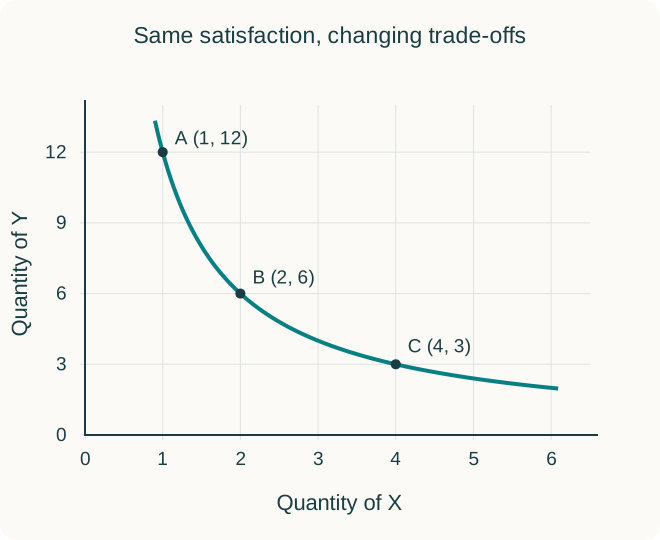
This separate illustration uses the curve Y = 12 / X. It passes through A = (1, 12), B = (2, 6), and C = (4, 3).
Calculate the interval trade-offs:
- A to B: 6 units of Y lost for 1 X gained, giving MRS = 6.
- B to C: 3 units of Y lost for 2 X gained, giving MRS = 1.5.
The second interval is flatter. It takes less sacrifice per extra X to stay on this same curve.
If you know differentiation, the tangent slope is -12 / X², so point MRS is 12 / X². At B, where X = 2, point MRS is 3. It differs from both interval calculations because it describes the trade-off exactly at B.
A straight downward line has constant MRS. A downward curve that becomes steeper to the right has increasing MRS. Neither demonstrates diminishing MRS.
Property 3: Higher Curves Represent Higher Satisfaction
Suppose A = (2, 6), B = (4, 6), and C = (4, 9).
B is preferred to A because it offers more X and the same Y. C is preferred to B because it offers more Y and the same X. Their indifference curves must reflect that ranking.
For ordinary desirable goods, a curve to the northeast therefore represents greater satisfaction. But higher satisfaction does not mean twice the satisfaction, even if a diagram labels the curves U1 and U2. Curve labels identify rankings, not measurable happiness gaps. MIT: Consumer Theory lecture summaries
Also, do not rank two arbitrary bundles merely by adding their quantities. Ten portions in total need not be preferred to nine if the mixtures differ. Compare A = (1, 9) and B = (5, 4): one has more Y, the other more X. You need information about the consumer’s preferences.
Property 4: Two Distinct Indifference Curves Cannot Cross
This proof becomes manageable when you choose the comparison points carefully.
Imagine two supposed indifference curves crossing at A = (2, 8). Put B = (5, 6) on one curve and C = (5, 3) on the other.
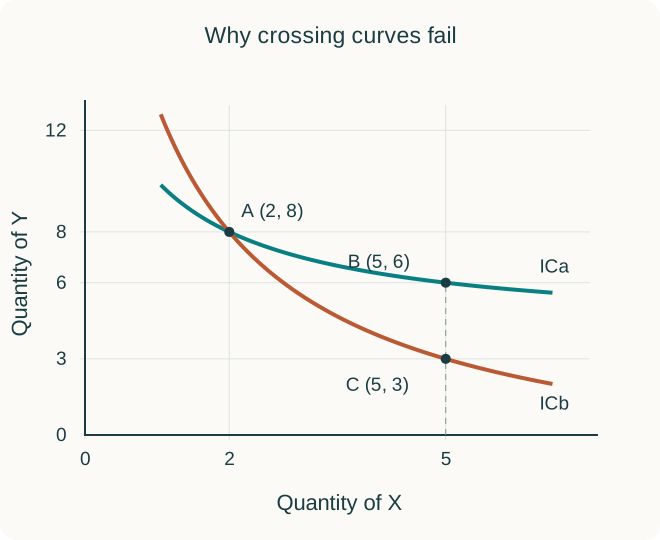
Follow the argument in four steps:
- A and B share a curve, so the consumer is indifferent between A and B.
- A and C share the other curve, so the consumer is indifferent between A and C.
- Consistency implies B and C are equally preferred, because both are equally good as A.
- But B has 5 X and 6 Y, while C has 5 X and 3 Y. With the same X and three extra Y, B must be preferred to C.
B cannot be both equally good as C and strictly better than C. Therefore, the proposed crossing is impossible under these preferences. Oregon State: Preference and Indifference Curves
How to Present the Proof Clearly
Draw B and C vertically above one another, so equal X is obvious. Label the common point A. Then write the equal-satisfaction chain before comparing quantities.
Do not stop at “two curves represent different utility levels”. Showing the actual contradiction explains why the drawing fails.
The rule concerns one consumer’s fixed preference map. Curves belonging to two different people can cross. There is no inconsistency in Riya and Kabir valuing the same baskets differently.
Two Special Shapes You Should Recognise
Perfect Substitutes: Straight Lines
Suppose a consumer cares only about the quantity of identical drinking water. Let X count one-litre bottles and Y count half-litre bottles, with packaging making no difference to satisfaction.
These baskets all contain three litres:
| X: one-litre bottles | Y: half-litre bottles | Total litres |
|---|---|---|
| 0 | 6 | 3 |
| 1 | 4 | 3 |
| 2 | 2 | 3 |
| 3 | 0 | 3 |
Each extra X replaces exactly two Y. The equation is Y = 6 - 2X, so MRSxy is constantly 2.
The indifference curve is straight because this consumer’s trade-off does not change with the mixture. This is a legitimate special case, not a badly drawn ordinary curve. NCERT: Theory of Consumer Behaviour
Perfect Complements: L-Shaped Curves
Now suppose X is a left glove and Y is a matching right glove. Only complete pairs are useful, and all gloves fit the same person.
The baskets (2, 2), (3, 2), and (2, 4) each provide two usable pairs. Extra unmatched gloves add no satisfaction. To obtain a third pair, the consumer needs at least three of each glove.
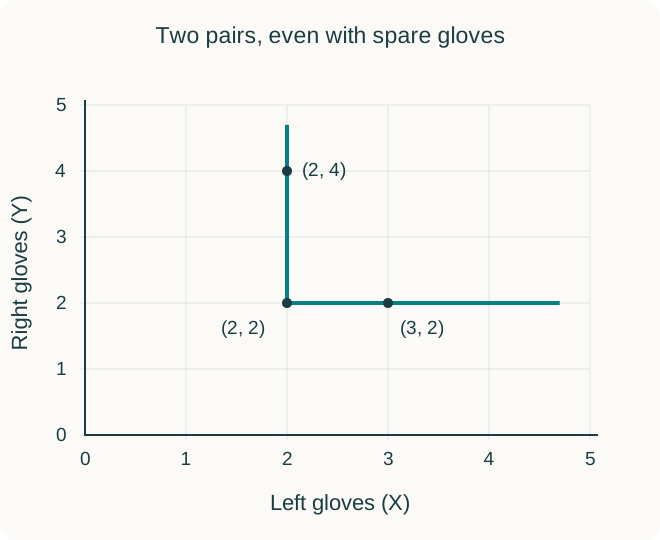
The horizontal part has zero MRS under our Y-per-X convention. The vertical part has no finite slope, and the corner has no unique tangent. There is no smooth, gradually diminishing MRS around the bend. EconGraphs: Perfect Complements
This example relaxes the assumption that extra units of either good, on their own, always improve satisfaction. That is why flat and vertical sections are possible.
An Indifference Curve Is Not a Budget Line
An indifference curve describes the consumer’s preferences. A budget line describes bundles that spend a given income at given prices.
Suppose X costs Rs 30 and Y costs Rs 10. The market requires giving up 3 Y to buy 1 X while keeping expenditure unchanged. That price ratio is 30 / 10 = 3.
Now suppose the consumer’s MRSxy at their current basket is 5. They would accept a sacrifice of up to about 5 Y for a small additional unit of X, but the market requires only 3 Y per X. There is an incentive to move toward more X and less Y.
At a smooth interior optimum with the usual convex preferences, MRSxy = Px / Py, and the chosen basket lies on the budget line. It reaches the highest attainable indifference curve. Tangency is not a universal rule for corners or L-shaped curves. OpenStax: Indifference Curves
Common Mistakes and Better Explanations
| Mistake | Better explanation |
|---|---|
| Equal satisfaction means equal quantities. | Different mixtures can be equally preferred. |
| MRS is simply the fall in Y. | Divide Y sacrificed by X gained. |
| Every downward curve has diminishing MRS. | Check whether it becomes flatter to the right. |
| A higher curve means a higher price. | Both axes show quantities; the curve ranks satisfaction. |
| Curves cannot cross because their slopes differ. | The problem is inconsistent preference rankings. |
| Curves must always be smooth and strictly convex. | Perfect substitutes and complements have special shapes. |
| Every bundle on an indifference curve is affordable. | Affordability requires income and price information. |
Try These Questions Before Checking the Answers
1. Equally preferred baskets are A = (1, 16), B = (2, 11), C = (3, 8), and D = (4, 6). Find the successive MRS values.
Answer: 5, 3, and 2 units of Y per extra X. The sequence is diminishing.
2. A consumer moves between equally preferred bundles (3, 14) and (7, 8). Calculate the interval MRS and signed slope.
Answer: Y sacrificed = 6; X gained = 4. MRS = 1.5 Y per X, while signed slope = -1.5.
3. Could (3, 7) and (3, 10) lie on the same ordinary indifference curve when extra Y is always desirable?
Answer: No. The second bundle has three more Y and the same X, so it must be preferred.
4. MRS values are 1, 2, and 4 as X increases. Does this schedule support the usual convex curve?
Answer: No. The sacrifice per additional X rises. It indicates increasing MRS over the stated intervals.
5. A and B are equally preferred. A and C are equally preferred. B contains the same X as C but more Y. Identify the contradiction under the standard assumptions.
Answer: Transitivity implies B and C are equally preferred; desirability of extra Y implies B is strictly preferred to C.
6. A consumer always replaces one unit of X with four units of Y without changing satisfaction. What is the shape and MRSxy?
Answer: A straight downward line with constant MRSxy = 4.
7. MUx = 24 and MUy = 8 at a smooth bundle. Px = Rs 20 and Py = Rs 10. Does the tangency condition hold?
Answer: No. MRSxy = 24 / 8 = 3, whereas Px / Py = 2. The willingness to sacrifice Y exceeds the market trade-off.
8. For matching gloves, do (4 left, 2 right) and (2 left, 4 right) deliver different numbers of usable pairs?
Answer: No. Each delivers two pairs. Both lie on the L-shaped curve whose corner is (2, 2).
A Quick Revision Routine
Draw one convex curve, then explain it aloud before looking at your notes. Start with equal satisfaction, identify what is gained and lost, and describe how the sacrifice changes.
Next, draw two crossing curves as a deliberate error. Put the two comparison points at the same X quantity and explain the contradiction in four lines.
Finally, calculate one MRS where X rises by more than one unit. If you remember to divide, state the units, and keep satisfaction unchanged, you have understood the central calculation.
Frequently Asked Questions
What does indifference mean in economics?
It means the consumer regards two bundles as equally satisfying. It does not mean the consumer dislikes the goods or cannot make decisions.
What is the formula for MRS?
With X gained and Y sacrificed, MRSxy = Y sacrificed / X gained. On a smooth curve, point MRS is the magnitude of the tangent slope. With positive marginal utilities, it equals MUx / MUy.
Why does an indifference curve slope downward?
When both goods are desirable, gaining one must be offset by losing some of the other to keep satisfaction unchanged.
Why is an indifference curve convex to the origin?
Under diminishing MRS, the consumer sacrifices progressively less Y for additional X as they move right. The curve therefore becomes flatter.
Can two indifference curves intersect?
Two distinct curves in one consistent preference map cannot intersect. A crossing would put a bundle in two different indifference classes. The usual proof shows that two other bundles would have to be both equally preferred and unequally preferred.
Is MRS negative or positive?
Here MRS is a positive sacrifice ratio, while the downward slope is negative. Some texts use signed MRS. Read the stated convention before applying a sign.
Does equal satisfaction imply equal expenditure?
No. Equally preferred baskets may cost different amounts. Prices and income determine affordability; an indifference curve alone does not.
Are all indifference curves strictly convex?
No. Perfect substitutes produce straight lines, and perfect complements produce L-shaped curves. Smooth strict convexity belongs to the usual diminishing-MRS case.
Can an indifference curve touch an axis?
It can in some preference models. For example, the three-litre water curve reaches both axes because either bottle size can supply all the water. Whether an axis is reached depends on whether a bundle with none of one good can provide that satisfaction level.
Does a higher indifference curve mean the consumer is richer?
No. It represents a higher preference ranking, not income itself. A larger budget may make higher curves reachable, but a curve alone does not tell you how much money the consumer has.
Looking for commerce tuitions?
Prachi is a gold-medalist commerce teacher with experience at Deloitte and KPMG. She focuses on fundamentals to build a strong foundation.